Harvard Physicists Question If Moon Has Enough Water for Future Cities
New research suggests that despite large water reserves, the lunar surface may struggle to support million-person colonies without significant recycling or new discovery.
By Layla Fontaine ·
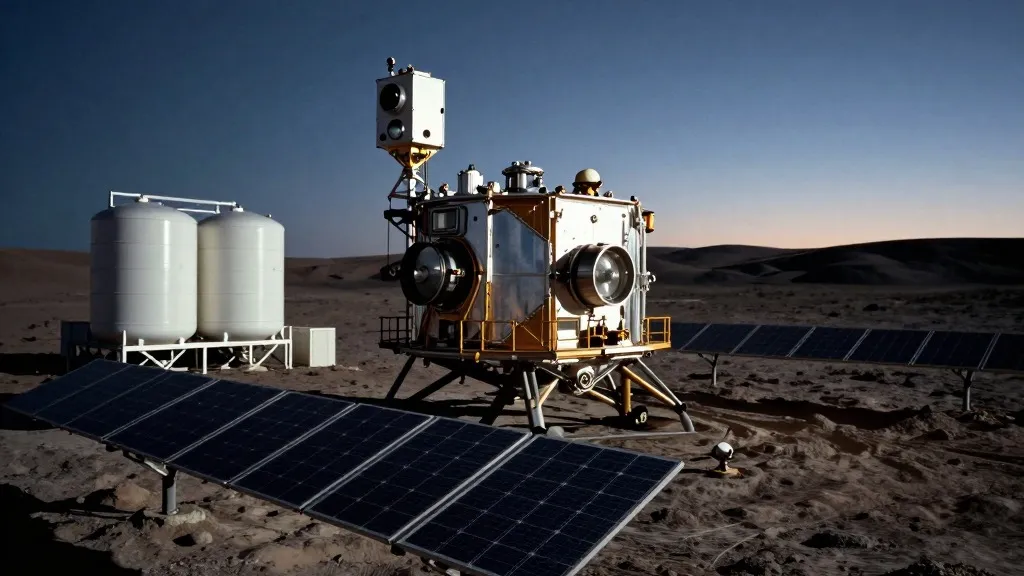
Major tech leaders have long promised that humanity’s next great expansion will happen on the moon rather than Mars, but a fresh analysis from academic researchers raises questions about whether the lunar surface can actually sustain such ambitious growth. The tension between corporate optimism and hard scientific data is now front and center in the debate over where and how fast we should expand beyond Earth. While the promise of rapid colonization remains popular, the new study highlights a critical bottleneck that could slow progress significantly.
The discussion gained momentum earlier this year when Elon Musk, the head of SpaceX, announced a strategic pivot toward building a self-sustaining city on the moon. He estimated this feat could be accomplished in less than a decade, a timeframe he deemed faster than settling Mars. Jeff Bezos, the founder of Blue Origin, has similarly envisioned a future where millions of humans reside in space by the mid-2040s. These bold statements prompted two scientists to look beyond the vision and examine the underlying resources required to make it happen.
Martin Elvis, a senior astrophysicist at the Smithsonian Astrophysical Observatory, and Jonathan McDowell, a professor at Durham University in England, published their findings in the journal Frontiers in Space Technologies. Their work zeroes in on two non-negotiable needs for any large off-world settlement: energy and water. The team found that generating power for a population of one million is a manageable engineering challenge using existing solar and nuclear technologies. The real difficulty lies in securing a sufficient water supply.
Current estimates suggest the moon holds roughly one billion tonnes of water, mostly located in permanently shadowed craters near the poles. According to the study, this volume would be enough to support one million people for approximately one century. This projection relies on a highly efficient recycling rate of 98 percent, a benchmark currently achieved on the International Space Station. If recycling efficiency drops, the timeline for water depletion shrinks considerably, putting pressure on the viability of long-term large-scale habitation.
Elvis offers a vivid comparison to help visualize just how much water this is. He likens the total estimated supply to a lake the size of Central Park, with water levels only reaching the head of the Statue of Liberty. He notes that while this amount sounds impressive on paper, it is essentially a small lake. A small lake is not designed to irrigate a sprawling metropolis indefinitely, especially without a reliable method for replenishing it.
Smaller populations would face less immediate pressure. The researchers calculated that a community of 10,000 people could remain sustainable for centuries under the same assumptions. McDowell emphasizes that if humanity wants to replicate the cityscapes seen in science fiction, we must find a way to transport water to the moon or discover larger reserves, because the current supply is insufficient for that scale.
The baseline estimate of one billion tonnes may even be optimistic. Elvis suggests the actual recoverable amount could be 20 or 30 times smaller, with only a fraction of the total water being accessible. His conservative estimate is that we can count on about one percent of the original figure, which would reduce the sustainable timeline from 100 years to roughly one year. Additionally, planetary geologist Gordon Osinski notes that satellite data carries uncertainty. He suggests the water might exist in a form similar to Arctic permafrost, mixed into soil in tiny crystals that are difficult to extract, requiring ground-based confirmation to be certain of its usability.
Despite these constraints, the researchers do not see the findings as a reason to abandon lunar exploration. McDowell argues that understanding the limits is better than blindly pursuing goals that cannot be met. He believes the truth of the data is neutral, and only negative action stems from ignoring it. This perspective encourages a measured approach, focusing on what is currently possible while continuing to search for more resources.