France Detains 11,650 Students as 70,000 Police Deployed
The government has expanded its security forces to the largest scale in decades while student protests against school infrastructure failures continue.
By Carmen Wojcik ·
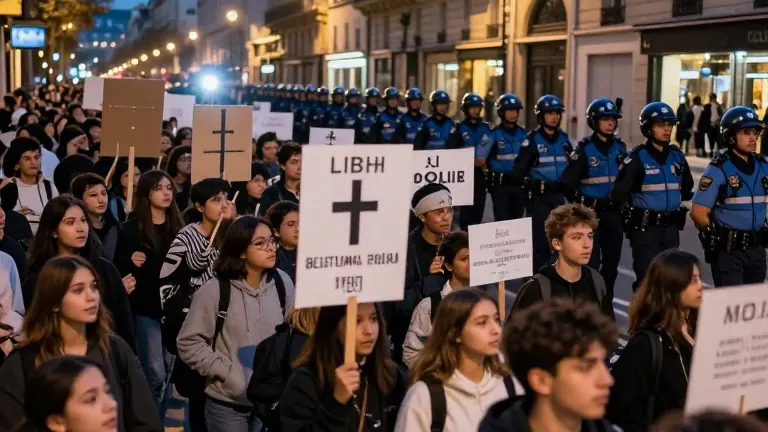
French police made 1,000 arrests on Monday, bringing the total number of students placed in custody since the protests began in September to 11,650. These figures follow the deployment of 70,000 police officers to the streets, a move that marks the heaviest law enforcement response to a student movement in France in decades. The government has framed the unrest as a series of riots, a narrative that justifies the expanded security presence while critics argue it diverts attention from the structural issues driving the mobilization.
The protests were triggered by deteriorating conditions in schools across the country. In Acoua, a secondary school on the island of Mayotte built for 900 students now houses 2,300 in cramped classrooms with poor ventilation. The school has faced water supply failures and unsanitary toilets since August 31. Similar complaints have emerged in Parisian suburbs, where students at Blaise-Cendrars secondary school in Sevran have reported water leaks, mould, and a shortage of furniture since 2024. At Marcelin-Berthelot secondary school in Pantin, windows remain sealed shut despite heatwaves reaching 40 degrees Celsius.
The strain on the education system is quantified in the ministry’s own data. In the 2024 to 2025 academic year, state secondary schools failed to deliver 20.2 million teaching hours. This represents nearly one in every ten scheduled lessons. Fifteen million of those lost hours were attributed to absent teachers who were not replaced. French economist Lucas Chancel notes that government spending per student has fallen by 20 percent since President Emmanuel Macron took office in 2017. These financial cuts coincide with poverty rates reaching their highest levels since the 1990s, with 9.8 million people now living below the official poverty line.
Violence has marked the protests, but injuries have also been inflicted by police forces. Fourteen-year-old Eden suffered a fractured jaw and lost teeth from a tear gas grenade. Sixteen-year-old Mael lost sight in one eye to a suspected rubber bullet. Fifteen-year-old Evan lost a hand to a stun grenade. By October 14, 7,950 people were in custody, 85 percent of whom were minors. An additional 2,700 were detained after the October 17 demonstrations. The scale of these detentions has led observers to describe this as one of the most repressed protest movements of the century.
President Macron addressed the public, stating he understood the students but did not express the same level of support he offered to police officers. In a meeting with 20 students on Friday, his administration promised to reform the university entrance platform. This concession did not address the primary demands regarding school infrastructure and funding. Prime Minister Sebastien Lecornu has urged the political left to choose a side, framing the issue as a conflict between the Republic, represented by the police, and rioters with a violent agenda.
Macron has pledged to ban protests and accused the far left of attempting to bring down the republic. Far-right politicians have seized on the chaos, denouncing groups of thugs of foreign origin and calling for expanded powers to strip citizenship from some residents. This rhetoric allows the government to position itself as the defense against the far right, appealing to voters through fear rather than its governance record. The administration appears content to wait for the movement to exhaust itself or be weakened by the heavy police presence.
The next phase of the protests will see continued deployment of the 70,000 officers. The government has no announced schedule for new negotiations with student leaders. The current strategy relies on maintaining a visible police presence to deter further mobilization until the economic pressures that sparked the unrest are resolved.