70,000 Officers Deployed as France Tackles Second Wave of Protests
A massive security presence aims to prevent violence during new demonstrations against school conditions and rising costs, following a week of significant unrest.
By Layla Fontaine ·
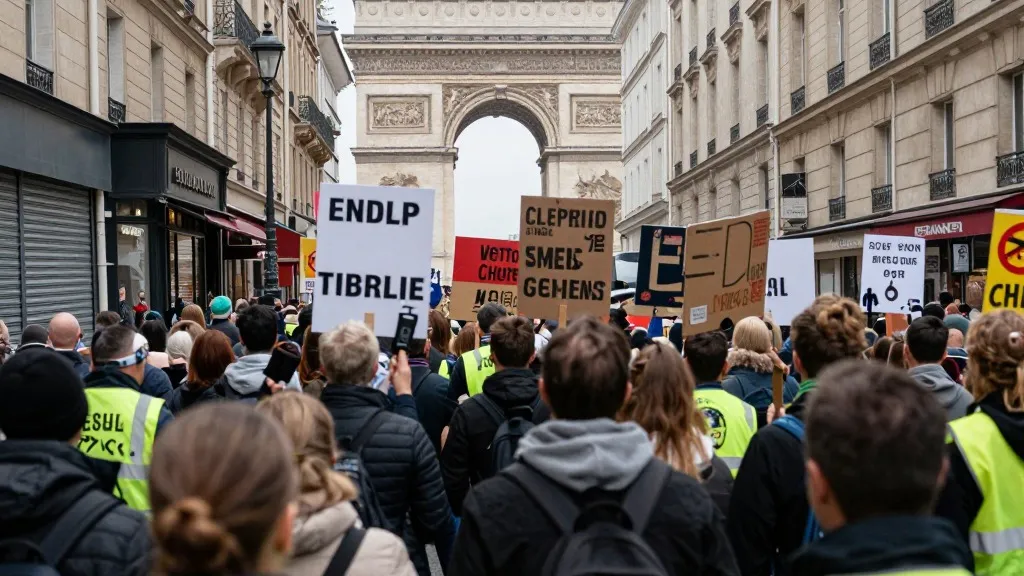
French authorities have mobilized a force of more than 70,000 police officers and gendarmes nationwide to manage a second wave of mass protests that began on Saturday. This significant deployment is designed to prevent a repeat of the violence seen one week prior, when largely peaceful marches were disrupted by looting and clashes that resulted in over 2,000 arrests. The current demonstrations focus on deteriorating school infrastructure and the increasing cost of living, marking a continuation of the unrest that started in mid-September.
The primary march in Paris followed a strictly controlled route from Porte d'Italie to Porte de Vincennes along the Boulevards des Marechaux. Local officials designated this as the only permitted path after banning an earlier negotiated itinerary between Place de la Bastille and Place de la Nation. Restrictions also prevented non-union groups from organizing their own protests, a decision that frustrated many participants who felt the government was trying to limit the visibility of the movement. One retired education worker, speaking without giving her last name, stated that the routing changes gave the impression that authorities wanted to make the demonstration invisible.
Despite the strict guidelines, the crowds in Paris were diverse, including students, teachers, nurses, and union representatives. Participants maintained a mostly peaceful tone, dancing and chanting slogans that ranged from witty critiques to calls for President Emmanuel Macron to resign. Some groups specifically targeted economic inequality, with one crowd shouting that there were too many billionaires and that they were preparing for revolution. Other demonstrators chanted that they were all anti-fascists, reflecting the political tensions currently simmering in the country.
In response to the anticipated crowds, businesses in central Paris took precautions to protect their assets. Many shops closed early or covered their windows with protective panels, while some retailers hired private security to monitor their premises. The transit system was also impacted, with at least 24 metro stations closed at the request of the police prefecture. Major cultural institutions, including the Louvre and the Musee d'Orsay, closed their doors for the day, and Art Basel Paris cancelled its weekend programming to avoid potential disruptions.
Interior Minister Laurent Nunez confirmed that the current deployment is 20 percent larger than the force used the previous weekend. The strategy involved using the elite RAID unit to support broader police operations rather than directly managing crowds, a shift aimed at maintaining order without escalating tensions. By early Saturday afternoon, police reported that the situation remained calm, with at least 135 arrests made nationwide and various weapons seized. While the central Paris march proceeded without major incident, other cities faced stricter controls, with protests banned in the downtown areas of Montpellier, Rouen, and Nice.
In Marseille, a union march was authorized under strict conditions, while police in Lyon used tear gas to disperse a group of about 150 demonstrators. The Yellow Vest movement has also announced plans for its own protest on October 31, indicating that public dissatisfaction is not limited to the current wave. The unrest traces back to mid-September when high school students began blockading schools to protest dilapidated buildings and teacher shortages. Last week, President Macron met with student representatives for the first time since the crisis began, promising more teachers and a major overhaul of the university admission system known as Parcoursup.
The timing of these protests is politically significant, occurring about six months before a pivotal presidential election in which Macron is barred from seeking a third term. With his departure from office due in 2027, the current turmoil affects the political landscape considerably. Marine Le Pen, who has long campaigned on restoring law and order, currently leads recent polls by a wide margin. The political stakes were highlighted in Orleans, where thousands of protesters shouted anti-fascist slogans as her National Rally held a party congress. Authorities expected between 20,000 and 30,000 people to join a counter-demonstration in that city, underscoring the deep divisions in French society as the election year approaches.