New Maps in Seven Key States Face Reality Check on Election Day
Redistricting aimed to secure Republican majorities, but voter behavior in these redrawn districts may defy the math.
By David Almasi ·

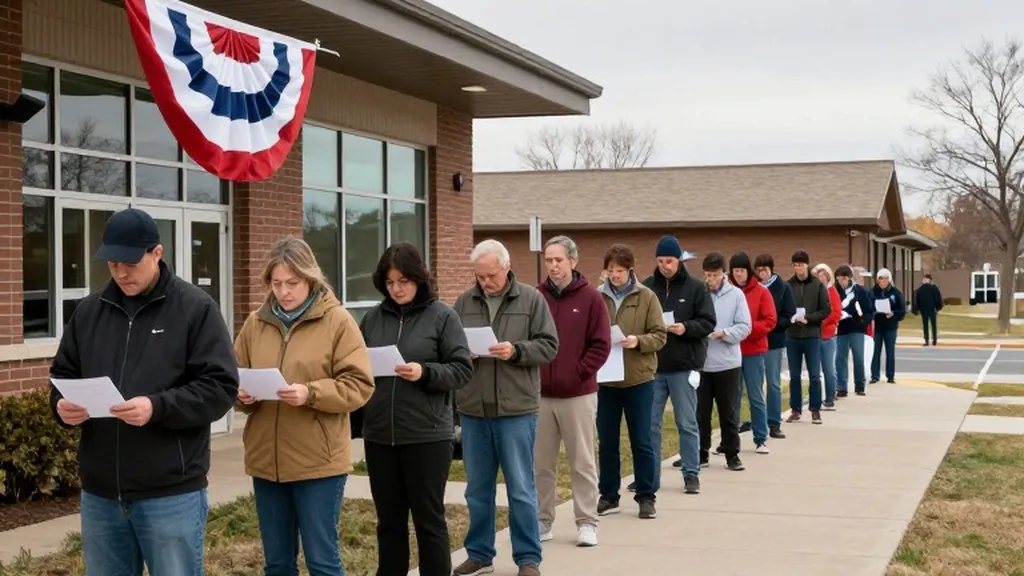
Voters across the United States are casting ballots on Tuesday, November 3, 2026, to determine the balance of power in Congress for the final two years of President Donald Trump's second term. All 435 seats in the U.S. House of Representatives are up for election, along with 35 Senate seats. The outcome will shape the legislative landscape for a Republican president who faces a divided electorate and a challenging economic environment.
A significant aspect of this midterm cycle involves the use of new congressional maps in seven states: California, Florida, Missouri, North Carolina, Tennessee, Texas, and Ohio. These districts were redrawn following mid-decade redistricting efforts. The primary strategic goal for Republicans was to create districts that would help them retain or expand their majority in the House, which currently stands at 218 seats. Democrats hold 214 seats, with one independent and several vacancies.
However, the effectiveness of these new maps is being tested today. While the lines were drawn with specific political calculations in mind, historical voting patterns suggest that districts do not always perform as predicted. In many of these states, the new lines combine areas that have historically voted in different ways or shift boundaries in ways that may alter local dynamics. The AP notes that while Republicans tried to beat the typical midterm pattern of losing seats through redistricting, the results remain uncertain.
In Texas, Florida, and other large states with new maps, the districts were designed to consolidate Republican strength. Yet, the AP reports that new districts in these areas may not vote as drawn. This uncertainty is heightened by the fact that 60 House incumbents did not run again, including 37 Republicans. This high turnover rate introduces new faces into races that were previously stable, potentially shifting the baseline expectations for how these redrawn districts will behave.
The Associated Press describes the election as a referendum on the president's performance, with voters struggling with high prices and angry over an unpopular war with Iran. AP-NORC polling indicates that 35% of U.S. adults approve of Trump's job performance, while 25% approve of his handling of the economy. About 7 in 10 say the country is heading in the wrong direction. These national sentiments are playing out in specific districts where the new maps were intended to buffer against such national headwinds.
In North Carolina, the new map has created competitive environments that differ from previous cycles. Democratic former Governor Roy Cooper is facing former Republican National Committee chair Michael Whatley in the Senate, a race that has drawn national attention. In the House, the new districts in states like Ohio and Missouri were crafted with the assumption that they would lean more heavily Republican than their predecessors. But with high early vote totals surpassing those from four years ago in many closely watched states, the final tally may reflect a more complex mix of local and national issues.
The financial stakes of these districts are also significant. The 2026 elections are likely to be the most expensive in history. Republican committees outraised and outspent Democratic committees, aided by Trump-affiliated groups and Elon Musk. AP analysis of AdImpact data shows that 88.1% of Republican general election TV ad spending went to states and districts Trump won in 2024. This heavy spending suggests a confidence in holding these areas, but it also indicates an awareness of the competitive pressure in the newly drawn districts.
In California, which largely votes by mail, the new congressional map was part of a broader state effort to adjust district lines. The state's 21 Democratic-held districts that voted for Trump in 2024 are a point of focus, as are the nine Republican-held districts that voted for Kamala Harris. These cross-party voting patterns suggest that the new lines may not perfectly align with partisan identity, adding another layer of complexity to the prediction models used by analysts and political strategists.
RNC Chairman Joe Gruters emphasized the importance of turnout, stating that everything depends on voters showing up. This focus on mobilization is critical in the new districts where margins may be tighter than expected. Democrats, led by DCCC Chair Rep. Suzan DelBene, argue that the American people are angry and want change. This sentiment is resonating in districts where economic concerns, such as rising costs for healthcare and taxes, are driving voter decisions.
As polls close across the country, the reality of the new congressional maps will be revealed in the final vote counts. The districts in California, Florida, Missouri, North Carolina, Tennessee, Texas, and Ohio will serve as key indicators of whether redistricting achieved its intended political goals or if voter behavior remained independent of the new boundaries. The results will determine not just who controls the House, but also the viability of future redistricting strategies in other states.
With over 57 million people having already voted, the early turnout suggests a high level of engagement that could influence the final numbers in these critical districts. The AP notes that one or two seats could tip either chamber, making the performance of these new maps even more consequential. As the count continues, the interplay between the drawn lines and the actual votes will define the legislative path for the next two years.