Borderland Opium: Satellite Data Reveals 9,000 Hectares of Poppies in Balochistan
Afghan farmers are leasing Pakistani land to expand cultivation following the Taliban's 2022 narcotics ban, according to new satellite analysis.
By Layla Fontaine ·
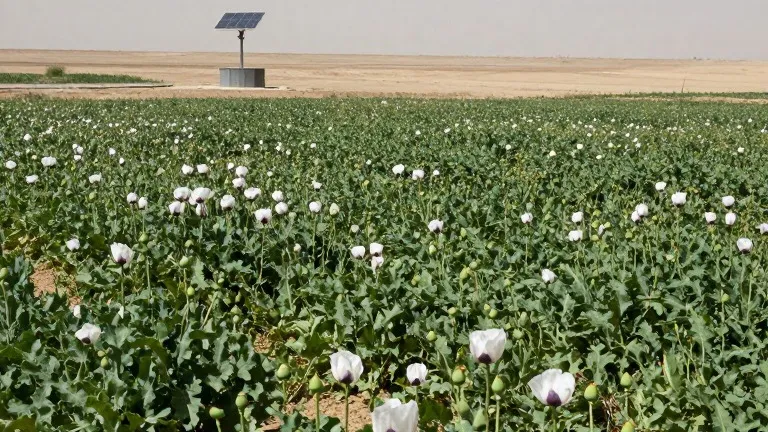
Afghanistan’s opium production has declined since the Taliban banned illicit narcotics in 2022, but satellite imagery indicates the crop is migrating across the border into Pakistan and Iran. The shift is particularly evident in Pakistan's Balochistan province, where new planting has emerged.
David Mansfield, a UK-based expert on illicit drugs, stated that satellite assessments by the British firm Alcis identified more than 9,000 hectares of poppy cultivation in Balochistan. The majority of this acreage is located in the districts of Loralai and Killa Abdullah. Mansfield described these remote borderlands as a global center for opium production, driven by instability in the tri-border area.
Afghan growers from Kandahar and Helmand provinces are leasing land in Pakistan, bringing capital and agricultural expertise to the region. Residents report that these farmers invest millions of Pakistani rupees in solar-powered wells and share profits with local landowners. Monawar Hussain, the chief administrative officer of Killa Abdullah district, claimed that an eradication campaign last year reduced cultivation, but Alcis data from 2026 shows no clear evidence of that reduction.
Local officials and farmers cite economic factors for the expansion. Lala Jan Kakar, a resident of Killa Abdullah, noted that drought and flash floods have damaged traditional fruit farming. He stated that the demand for poppies and the resulting income far exceed those of other crops. Abdul Qahar Wadan, a former National Assembly member, alleged that senior military officials and power brokers back the cultivation in exchange for commissions.
Similar patterns are observed in Iran's Sistan-Baluchistan province, where Afghan farmers work as tenants. Satellite imagery from 2026 shows extensive fields using drip irrigation, suggesting growers invested with low expectations of eradication. Mansfield noted a transition from mixed farming to large-scale poppy monoculture in both countries, with many farmers doubling their cultivated land in 2026.
Pakistan’s Interior Ministry did not respond to requests for comment, though the United Nations Office on Drugs and Crime estimates production remains marginal while acknowledging spillover effects. In Afghanistan, cultivation has rebounded in Badakhshan province, which accounts for roughly half of national output. Mansfield warned that if farmers interpret recent Taliban concessions as tolerance, opium production could rise sharply in 2027.