Washington Cemetery in Brooklyn Remains Full of History
The historic Jewish burial ground in Midwood has reached capacity, holding over 200,000 interments while facing legal hurdles over unused plots.
By Carmen Wojcik ·
Brooklyn’s burial history dates back to the 19th century, when the independent city moved its dead to the edges of Kings County. Today, researchers continue to document sites that were forgotten, built over, or repurposed as the borough expanded.
Washington Cemetery in Midwood stands as the largest Jewish burial ground in Brooklyn. Established in 1850 by lawyer James Arlington Bennet, the site began as a nonsectarian facility intended for middle-class families. Bennet marketed it as the cheapest option in the state and is interred there with his family. The cemetery was consecrated as a Jewish site in 1857, a shift driven by the influx of immigrant communities.
The expansion of Washington Cemetery was fueled by burial societies known as chevra kadishas. These groups pooled monthly dues from members to cover the costs of plots, headstones, and coffins. In exchange, the societies provided a dignified burial and a reserved space for members and their families. At least 30 of these societies hold plots within the five gated sections of the cemetery. Most of the interred individuals were Jewish immigrants from Eastern Europe and Russia.
By 2008, the cemetery announced it had run out of available space. The facility is now divided by Bay Parkway, with the oldest section bordered by Ocean and McDonald avenues. Funeral directors were forced to carry coffins from the street into the grounds as parking lots and roadways were converted into gravesites. The site now holds the remains of more than 200,000 people.
Although several hundred empty plots remain, they belong to long disbanded funeral societies. Legal challenges complicate the process of freeing up this land for new burials. The cemetery remains one of the most recent active burial sites in the city to reach full capacity. It also contains the graves of early Yiddish theater performers, writers, and two well-known Jewish gangsters who died in 1912.
Elsewhere in Brooklyn, the Brooklyn Naval Hospital Burial Grounds have undergone a dramatic transformation. The Navy established the hospital in 1825, and the adjacent cemetery operated from 1831 to 1910. It served sailors, dock workers, and civilians, including two Congressional Medal of Honor recipients. Records indicate that at least 10 percent of the more than 2,000 buried there were African Americans.
The site suffered from neglect in the late 19th century, with rusting iron fencing and broken markers. In 1926, the Navy moved 987 remains to Cypress Hills Cemetery, though hundreds of burials remain unaccounted for. The Navy turned the yard over to New York City in the 1990s, leading to questions about the unmarked graves beneath the surface.
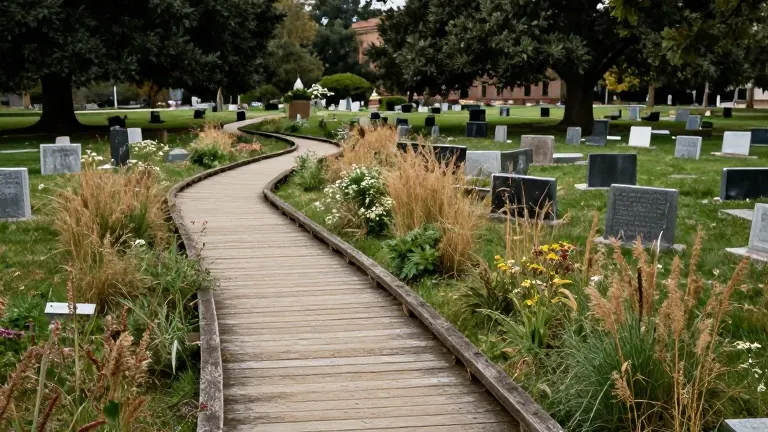
The former playing field is now the Greenway Botanical Garden at the Naval Cemetery. Nelson Byrd Woltz Landscape Architects designed a nature preserve with more than 50 species of native plants. A raised boardwalk allows visitors to explore the meadow without disturbing the ground below. The Brooklyn Greenway Initiative, a nonprofit based in the Navy Yard, serves as the steward of the garden. The site’s tenth anniversary was celebrated this summer.
Friends Cemetery in Prospect Park offers a different preservation model. The Quakers purchased the farmland in 1849 and reinterred their dead there by 1851. The 10-acre site is private property within the park and remains open to the public only on rare occasions. It holds over 3,500 people, including former Brooklyn borough president Raymond Ingersoll and educator Mary McDowell.
Quakers initially avoided tombstones to prevent vanity, a rule that relaxed in the 1850s to allow simple markers. The New York Quarterly Meeting, the organizational body for the Friends of Brooklyn and Manhattan, owns the land in perpetuity. The cemetery sits on a hill near the border with Flatbush, surrounded by the fields and forests that make up Prospect Park.