Older Tools Cost Chinese Chipmakers Triple for Same Output
Morgan Stanley data shows CXMT yields one-third the bits per wafer of Western rivals, driving up costs as export controls block EUV access.
By David Almasi ·
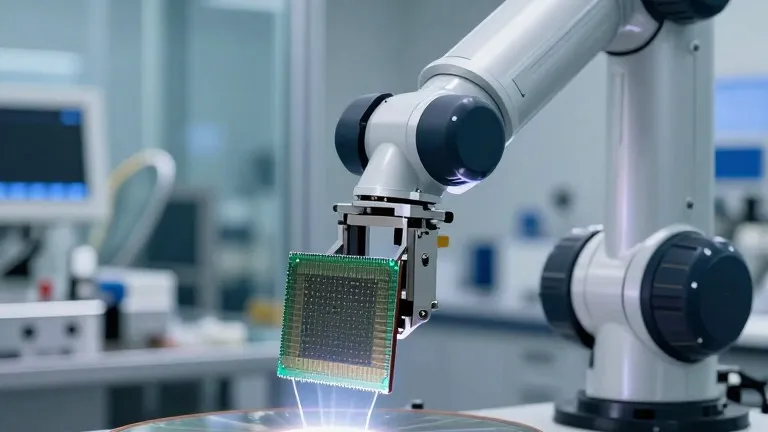
Chinese chip manufacturers face higher production expenses and lower yields because they must use older equipment to bypass export restrictions. The ban on extreme ultraviolet lithography machines from ASML forces producers to rely on deep ultraviolet tools, which require multiple steps to print a single layer of a chip. This process increases the chance of defects and extends manufacturing time, raising the final cost of silicon for consumers and businesses.
Morgan Stanley estimated in a June report that Chinese DRAM maker CXMT produces only about one-third as many bits per wafer as Western competitors. The bank described lithography access as a hard ceiling for Chinese memory development. Chris Mack, co-founder and CTO of Fractilia, explained that industry standards indicate three exposures on a 193 immersion tool cost roughly the same as one EUV exposure. At four masks, the older technology becomes the more expensive option for manufacturers.
The physical constraints of the process force designers to add space around chip features to manage alignment errors. This enlarges the chip and reduces the number of usable dies per wafer. Since wafers cost tens of thousands of dollars each, losing potential die increases the price per unit. Mack noted that manufacturers sell finished dies, not raw wafers, making the reduction in die count a direct financial loss.
SMIC has used this multi-step DUV method to produce the Kirin 9000S and Kirin 9030 processors for Huawei. Analysis suggests the Kirin 9030 process approaches the density of 5nm manufacturing, though it still lags behind leading processes from TSMC and Samsung. Morgan Stanley expects CXMT to continue using 1-alpha DRAM without EUV, increasing its share of global DRAM bit supply from 14% in 2026 to 16% in 2028 through new production capacity.
The bank projects that China's self-sufficiency in AI chips will rise from 42% in 2025 to 70% by 2030. Despite this growth, gaps remain in EUV access, high-bandwidth memory, and advanced software. Micron developed its 1-alpha DRAM without EUV, but eventually moved to EUV for its 1-gamma generation to achieve 30% greater bit density. Mack stated that he would be hard pressed to believe a 3nm or 2nm node could be economically viable without EUV, suggesting a persistent cost advantage for Western producers in the most advanced logic chips.
More Business · Tech news · Business Watchdog · Report a business · Got a Story?