Brazilians Split 47 to 45 in Final Push for Presidential Power
Two presidential rivals closed a tight campaign with massive rallies in Rio and Minas Gerais, leaving voters to choose between a fourth Lula term or a continuation of the rightward shift.
By Carmen Wojcik ·
The margin of separation between Brazil's two leading presidential candidates stands at a razor-thin two percentage points, a gap that has defined the final hours of a highly contested run-off. On Saturday, the last day of official campaigning, millions of Brazilians prepared to cast their votes in a race that recent polling describes as effectively tied. The outcome will determine whether the country maintains its current left-wing leadership or accelerates a broader regional trend toward the right.
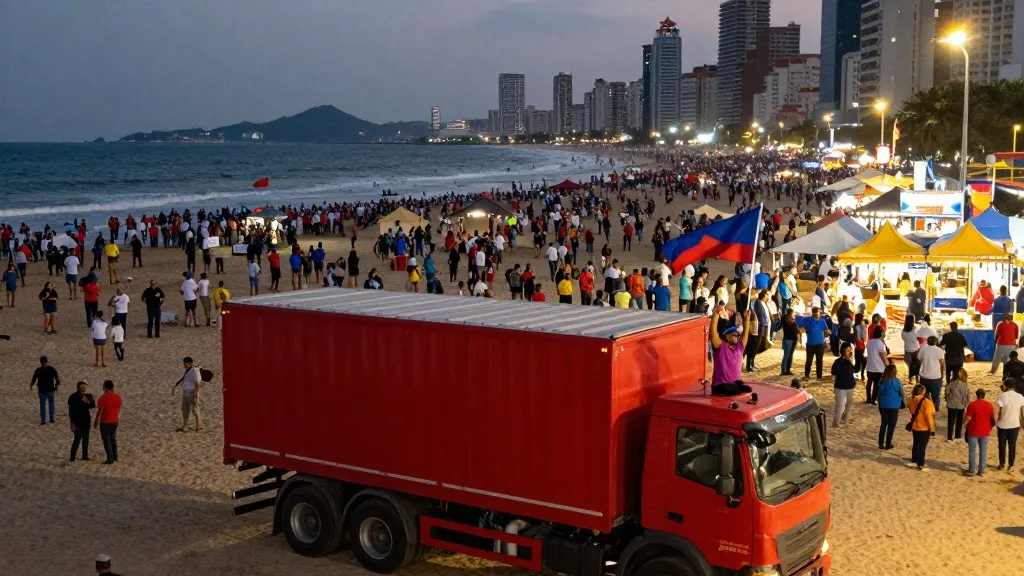
Luiz Inacio Lula da Silva, the 80-year-old incumbent, capped his campaign with a high-energy appearance at Copacabana Beach in Rio de Janeiro. Wearing a red hat and standing on a campaign truck, Lula addressed hundreds of supporters while waving a Brazilian flag. He sought to frame the election as a choice of national identity, contrasting his own patriotism with his rival's perceived closeness to the United States. "The people must choose either someone who kisses the national flag or someone who kisses the American flag," Lula told the crowd.
Lula is seeking a fourth term in office, which would be his second non-consecutive stint as president. His campaign has focused on consolidating his legacy, but the race remains fiercely competitive. The incumbent's challenge is not just to retain his own base but to sway undecided voters who are watching the economic and social trajectories of both major parties with keen interest.
In the southeastern state of Minas Gerais, Flavio Bolsonaro held his own significant rally to close his campaign. The senator and son of former President Jair Bolsonaro drew a large crowd that included hundreds of motorcyclists dressed in the national yellow football jerseys. Bolsonaro captured 47 percent of the vote in the first round, slightly ahead of Lula's 45 percent. Recent data from a CNT/MDA poll released on Saturday shows Bolsonaro leading by a narrow 1.3 percentage point margin, with his support at 46.3 percent against Lula's 45 percent.
The polling data indicates a stagnant race over the final week. A week prior to the Saturday release, the same poll had Bolsonaro ahead by a slightly wider 0.9 percentage point margin, standing at 46.8 percent to Lula's 45.9 percent. With a margin of error of 2.2 percentage points, the statistical reality is that both candidates are effectively tied within the range of uncertainty. This near-equality suggests that a small number of voters could tip the balance in either direction on Sunday.
Supporters of Bolsonaro emphasized themes of personal responsibility and national values during their gathering. Ebert Dorigo, a motorcyclist at the event, spoke to AFP about the perceived cultural shift under the current administration. He argued that the Workers' Party had fostered a reliance on state welfare, which he believes has hindered individual progress. "The values we uphold are nation and family," Dorigo stated, adding that hard work is the primary path to achievement.
The campaign has been marked by sharp divisions over economic strategy, crime control, and the future direction of the state. Bolsonaro has pledged to tackle crime by adding hundreds of thousands of new prison spaces and reducing overall government expenditure. His platform resonates with voters who feel the current administration has become too bloated and ineffective. His father, Jair Bolsonaro, who led the country from 2019 to 2022, remains a central figure in the political narrative, currently serving a 27-year sentence for attempting a coup after his defeat in 2022.
Despite the intensity of the rallies, the candidates adopted a somewhat calmer tone during their final debate on Friday. While they continued to trade accusations regarding economic performance and past records, the exchange lacked the volatility of earlier stages in the campaign. For many voters, the choice remains difficult and unglamorous. Gabriela Ribeiro Viana, an event organizer, told AFP that the field of options feels limited. "If there were any other candidate, that would be a better option. But we're stuck choosing between the worst, the horrible, and the lesser evil," she said, capturing the sentiment of a divided electorate.