Two-Week Ice Trap Tests Russia's Northern Sea Route
Sanctioned tankers stranded in the Vilkitsky Strait reveal the logistical gaps behind Moscow's ambitious Arctic trade targets.
By Layla Fontaine ·
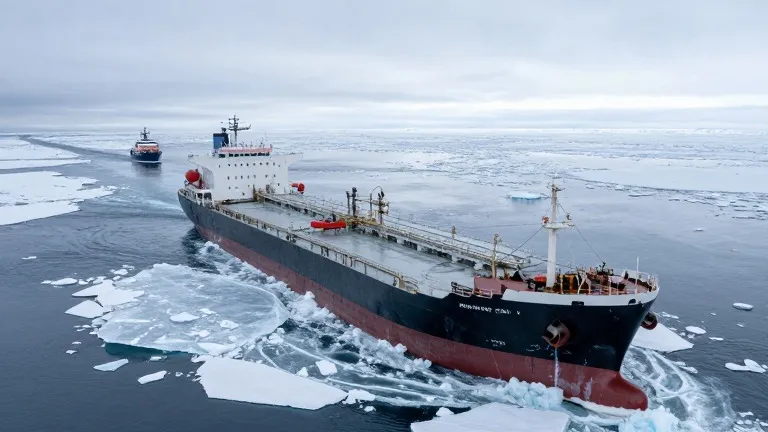
Two weeks. That is how long some sanctioned Russian tankers waited in the Vilkitsky Strait before abandoning the Northern Sea Route. The vessels became stuck in ice far above the Arctic Circle, a 55-kilometer choke point between the northern Siberian coast and Bolshevik Island. Only one tanker in the group successfully passed through. The rest eventually detoured after icebreakers failed to clear the path.
The incident challenges the Kremlin’s narrative of a reliable Arctic corridor. President Vladimir Putin described the route as a safe path to major markets. At the launch of the Vostok Oil project last month, he stated that 37 million tons of cargo moved along the route in 2025. He predicted that volume would almost double by 2030. However, independent data suggests a more modest reality.
The Center for High North Logistics reported that Russia shipped about 2 million tons of cargo along the full route to Asia by the end of September. Reuters later noted the total reached approximately 20 million barrels by mid-October. While this represents a 50 percent increase from 2025, it accounts for only about 1 percent of Russia's seaborne oil exports. Tomas Alexa, a senior analyst at Ambrey, characterized this growth as a surge from a relatively low base.
Ksenia Vakhrusheva, head of the Arctic project at Bellona, explained that less ice does not guarantee easier navigation. Melting ice can break up and pack tightly in narrow straits, blocking ships that lack specific ice-class ratings. This dynamic created the bottleneck that stranded the tankers in July.
Western sanctions further complicate operations. Alexa noted that Russia struggles to build and maintain Arctic-capable vessels. Spare parts and construction materials often require routing through third parties. Repair work previously handled by Norwegian, Danish, and Dutch firms is no longer available to Russian operators.
Other nations are testing the route's limits. South Korea reported on October 22 that its first container ship had used the Northern Sea Route. Officials noted difficult conditions, including large ice floes in the Bering and Vilkitsky straits. China also completed several scheduled container voyages to Europe this year, marking its first use of the route for such services.
Catherine Sendak of the Center for European Policy Analysis pointed out that Russia views much of the Arctic as an inner waterway. Questions remain regarding potential tolls and the services Moscow will offer commercial vessels. She expressed doubt that there are currently good answers to these operational uncertainties.