3 Billion Miles Away, Halley's Debris Creates 3 Bright Trails
A Georgia camera captured three meteors from the distant comet two days before the Orionid shower reaches its zenith.
By Layla Fontaine ·
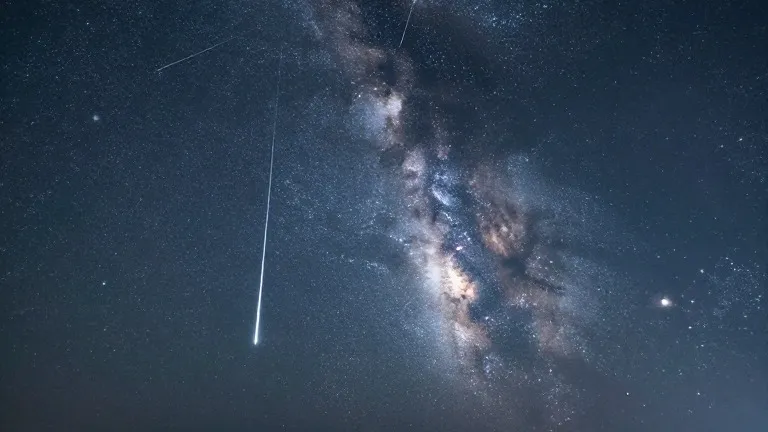
Three bright meteors streaked across the sky above Toccoa, Georgia, on October 21. The particles originated from Comet 1P/Halley, which currently sits more than 3 billion miles from Earth. Despite that vast distance, the debris shed by the comet continues to intersect with our atmosphere, producing visible light as it burns up.
Tim McCollum, an astrophotographer based in Georgia, recorded the event between 3 a.m. and 4 a.m. local time. The image captures the meteors as they race away from the shower's radiant point. This specific area of the sky lies near Betelgeuse, a red giant star in the constellation Orion. McCollum used a Canon EOS Ra camera paired with an RF 28-70 f2.0 lens to capture the data. He employed a star tracker to keep the equipment locked on the target area during multiple 30-second exposures. The final composite image was created using PixInsight software, which merges individual frames to enhance detail.
The photograph reveals a dense field of deep sky objects alongside the meteor trails. Orion's Belt appears on the right side of the frame, positioned near the Orion Nebula. The Rosette Nebula, known as Caldwell 49, is also visible within the dusty lanes of the Milky Way's galactic plane. Numerous star clusters are scattered throughout the diagonal band of the galaxy. This composition shows the interplay between transient meteor events and the static background of the night sky.
The Orionid meteor shower remains active until November 7. This window allows for further observations of Halley's debris. The shower builds toward its peak activity in late October. Observers can still expect to see meteors during the coming nights. The shower is one of the most reliable annual displays for northern hemisphere skywatchers.
Earth is currently passing through a separate debris stream left by Comet 2P/Encke. This stream produces the Taurid meteor shower. The intersection of these two streams can occasionally result in bright fireballs around Halloween. This overlap offers a potential bonus for those monitoring the sky during the active period. The presence of multiple debris fields increases the likelihood of observing brighter events.
McCollum's capture serves as a record of the shower's activity two days before its expected peak. The image documents the physical connection between a distant comet and the meteors visible from Earth. It provides a visual reference for the geometry of the radiant point and the surrounding star field. The data confirms that the Orionids are producing visible trails in the pre-peak period.